
 English
 Pусский
 한국어
한국어 中文
中文


Línea de producción de caucho completamente automática
Fully Automatic Rubber Production Line A fully automatic rubber production line is an advanced manufacturing system designed to streamline the entire process of rubber product manufacturing, from raw material processing to final product output, with minimal human intervention. This highly efficient and precise system integrates cutting-edge automation technologies, including robotics, computerized control systems, and AI-driven quality inspection, to ensure consistent product quality, high throughput, and reduced operational costs. Key Components and Workflow 1. Raw Material Handling and Mixing The process begins with the automated feeding of raw rubber compounds, fillers, and additives into a precision mixing system. Computer-controlled mixers ensure uniform blending, with real-time monitoring of temperature, pressure, and viscosity to maintain optimal material properties. 2. Extrusion and Molding The mixed rubber is then transferred to extrusion machines or injection molding units, where it is shaped into sheets, profiles, or specific product forms. Advanced servo-driven extruders and molds guarantee high dimensional accuracy, while automated cutting systems trim excess material for recycling. 3. Vulcanization (Curing) The shaped rubber undergoes vulcanization in temperature-controlled curing presses or continuous vulcanization tunnels. Automated systems adjust curing parameters (time, temperature, pressure) based on real-time sensor feedback to enhance product durability and elasticity. 4. Cooling and Finishing Post-curing, products move through cooling chambers to stabilize their structure. Robotic arms then handle secondary processes like deburring, surface treatment, or printing (e.g., logos, barcodes) with laser precision. 5. Quality Inspection and Packaging AI-powered vision systems and mechanical testers inspect each product for defects (e.g., air bubbles, dimensional errors). Approved items are automatically sorted, labeled, and packaged, while rejected units are diverted for reprocessing. Advantages - Efficiency: 24/7 operation with minimal downtime, significantly boosting production capacity. - Consistency: Eliminates human error, ensuring uniform product quality. - Cost-Effectiveness: Reduces labor costs and material waste through optimized processes. - Flexibility: Quick reprogramming allows switching between different rubber formulations and product designs. Applications Fully automatic rubber production lines are widely used in automotive (seals, tires), medical (gloves, tubing), industrial (gaskets, hoses), and consumer goods (footwear, seals) industries. By integrating Industry 4.0 technologies like IoT and predictive maintenance, these systems represent the future of smart, sustainable rubber manufacturing.
Producto
Categoría:
Equipos de caucho
-
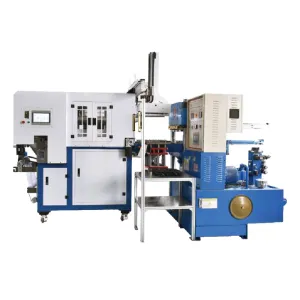
XQ (JS650-2S)/XQ (JS1100-2S) Equipo de automatización de caucho especializado para tapones de caucho médicos
Su clasificación: Equipos de cauchoVistas: 28Número:Tiempo de liberación: 2025-12-31 10:39:04Descripción del equipo:1. El equipo es adecuado para productos alimentados en hojas, lo que permite la producción sincrónica con dos moldes. Cada ciclo de vulcanización produce dos conjuntos de productos de molde, lo que ofrece una operación simple y una alta eficiencia de producción.2. La materia prima en láminas o rollos de caucho se somete a un proceso completo que incluye transporte y carga, corte longitudinal, vulcanización del producto, desmolde, embalaje del producto terminado, pulverización de agente desmoldante y limpieza del molde. Cuando se integra con una prensa vulcanizadora, form...
Noticias
Categoría:
-
[FAQ]Elegir entre equipos de automatización de caucho y silicona
2025-12-27 13:37:38
Caso
Categoría:
¡Sin resultados de búsqueda!
Video
Categoría:

Descargar
Categoría:
¡Sin resultados de búsqueda!
Reclutamiento
Categoría:
¡Sin resultados de búsqueda!
Productos recomendados
¡Sin resultados de búsqueda!


